
Article: What Is Ronghua? Chinese Velvet Flower Craft Explained
What Is Ronghua? Chinese Velvet Flower Craft Explained
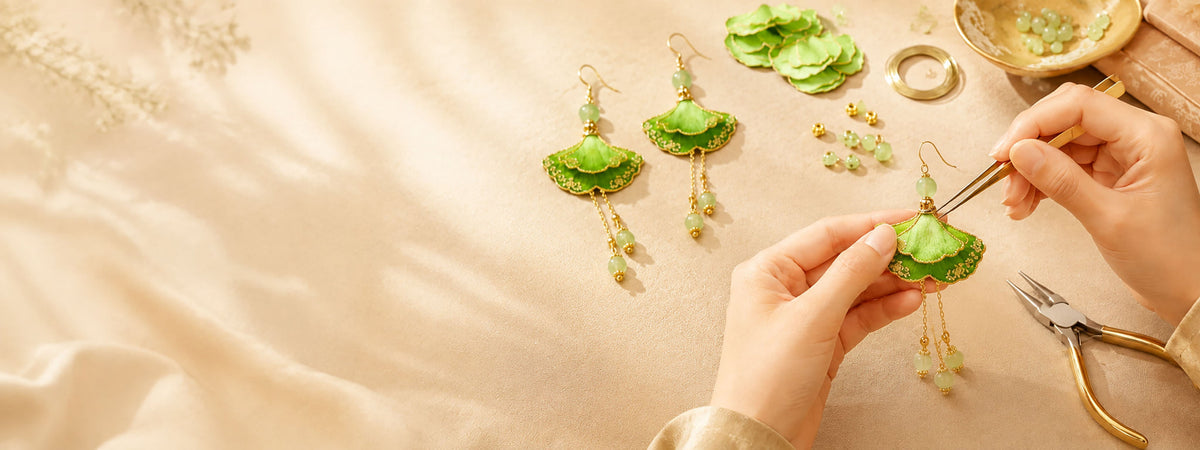
Ronghua (绒花) is a Chinese decorative flower-making tradition that transforms prepared fine fibres into soft, dimensional forms. The fibres are arranged around a supporting structure, trimmed, shaped and assembled into flowers, birds and other motifs. English speakers often call the result a “Chinese velvet flower” or “silk flower,” but the confirmed fibre composition should always be checked for the individual piece.
Ronghua is valued not only for its appearance but also for the knowledge embedded in its materials and sequence of making. A finished flower can look light and effortless, yet its form depends on careful preparation, even fibre distribution, controlled cutting and the patient assembly of many small elements.
Looking for a finished piece to wear? Browse our Ronghua earrings and accessories, then check the materials, dimensions and fittings on the individual product page.
What does Ronghua mean?
The Chinese name is written 绒花. The first character refers to a soft, downy or velvety texture, while the second means flower. The pronunciation rónghuā is also associated with the auspicious expression 荣华, which conveys ideas of prosperity, honour and flourishing. This sound association helps explain why Ronghua has been used in celebratory and decorative settings.
The cultural meaning should not be reduced to a single slogan. A flower’s motif, colour, intended occasion and local tradition can all affect interpretation. When CLMADE describes a specific design, we separate documented cultural context from a general decorative impression.
Is Ronghua the same as a silk flower?
Not exactly. “Silk flower” is a broad English phrase that can refer to many kinds of artificial flowers. Ronghua names a particular Chinese craft tradition and its characteristic approach to preparing, arranging, trimming, shaping and assembling fine fibres.
“Chinese velvet flower” is another useful English description because the finished surface can appear soft and velvety. It is still a translation aid rather than a complete material statement. Traditional accounts commonly describe silk fibres and copper-wire structures, but contemporary products and teaching materials may differ. The safest practice is to read the product-specific composition instead of assuming that every object carrying the Ronghua name is made from identical materials.
How is Ronghua made?
Terminology and the number of named stages vary among regional practices, makers and teaching contexts. Government and cultural sources describe multi-stage processes involving fibre preparation, dyeing or colour selection, arranging fibres around a supporting structure, trimming, shaping and final assembly. The outline below explains the logic of the process without claiming that every workshop uses an identical sequence.
1. Preparing the fibres
The raw material must first become clean, even and workable. In traditional silk-based practice, this can include processing, colouring, loosening and aligning the fibres. Preparation matters because uneven or tangled fibres will affect the surface and outline of the finished form.
2. Arranging fibres around a support
Aligned fibres are distributed around a fine supporting element. The support gives the soft material an internal structure and allows it to be bent or assembled later. Even distribution helps the finished strip maintain consistent density.
3. Cutting and refining the fibre strip
The prepared strip is cut and refined into small units. Controlled trimming reveals the soft fibre ends and establishes the scale of a petal, leaf, feather or other element. This stage strongly influences symmetry and texture.
4. Shaping individual elements
Each small unit is bent, curved, pinched or otherwise formed into the required outline. A flower is therefore built from shaped components rather than carved from a solid block. The maker controls the angle, volume and relationship of each part.
5. Assembling the final motif
Petals, leaves and supporting parts are combined into a finished composition. Additional structures or fittings may turn the motif into a hair ornament, earring, brooch, display object or another contemporary form.
Why do Ronghua flowers look different from one another?
Hand shaping introduces small variations in fibre direction, outline, spacing and curvature. These differences can make the work feel alive, but “handmade” should not be used to excuse a product that is damaged or materially different from its description.
A responsible product page should distinguish expected variation from confirmed specifications. The selected colour, principal form, dimensions, fittings and stated materials should remain consistent with what is offered, within any clearly disclosed handmade tolerance.
What materials are used in Ronghua?
Traditional descriptions often refer to silk fibres and fine copper wire. A wearable piece may also include earring posts or hooks, chains, pins, combs, clips, beads, backing materials, adhesives or plated metal components. Contemporary educational projects sometimes use simplified substitute materials to introduce the visual idea of the craft.
For this reason, the word Ronghua should not be treated as proof that an entire finished accessory is pure silk, solid precious metal or made by a particular certified practitioner. Check the confirmed material list for the exact item. CLMADE records decorative fibres, structural elements, fittings and surface finishes separately wherever the information is available.
Where is Ronghua associated with?
Nanjing is one of the best-known centres associated with Ronghua today. Nanjing government sources describe the making technique as a representative local intangible-cultural-heritage practice and document ongoing training, exhibitions and work by recognised practitioners. Related velvet-flower and velvet-bird traditions also exist in other places, including Beijing, with their own terminology and process descriptions.
That regional context matters. “Chinese Ronghua” is a useful broad introduction, but it should not erase differences among local traditions or imply that every contemporary object has the same place of production or heritage status.
Is every Ronghua product an intangible-cultural-heritage product?
No. A craft tradition can be listed or recognised as intangible cultural heritage, while an individual commercial object may not be independently certified. The status of a tradition, a representative practitioner, a workshop and a retail product are related but not interchangeable.
CLMADE uses heritage-related language to explain documented craft context. We do not present an individual item as officially certified unless that claim can be supported for the item itself.
How is Ronghua used today?
Contemporary Ronghua can appear in hair ornaments, earrings, brooches, decorative arrangements, costume, exhibitions and guided learning experiences. New formats can help the craft remain visible and relevant, provided that material claims, cultural context and maker attribution remain clear.
At CLMADE, Ronghua appears in small accessories designed to bring dimensional fibre work into contemporary dress. The goal is not to make every traditional form look the same, but to connect the craft language with an object that can be understood, worn and cared for today.
How should you care for a Ronghua accessory?
- Keep the fibre work dry and avoid perfume, hairspray, lotion and household cleaners.
- Handle the piece by its structural base or metal fitting, not by pulling the petals.
- Protect it from crushing, snagging and repeated friction.
- Store it separately in a clean, dry and rigid container.
- Avoid prolonged direct sunlight and high heat.
- Do not wash, soak, iron or reshape it unless product-specific instructions say to do so.
If a piece becomes compressed or wet, do not pull the fibres back into place by force. Allow surface moisture to air-dry away from direct heat and contact CLMADE with clear photographs if further guidance is needed.
How can you evaluate a Ronghua product description?
Look for specific information instead of broad cultural claims:
- What are the decorative fibres made from?
- What supports the shaped elements?
- What are the earring, pin or hair fittings made from?
- Are plated finishes distinguished from solid precious metals?
- Are dimensions and weight provided?
- What handmade variation should be expected?
- What care method applies to this exact construction?
- Is any heritage, maker or place-of-origin claim clearly supported?
These details help a customer understand both the beauty and the practical reality of the object.
Explore Ronghua at CLMADE
Browse the CLMADE Ronghua Silk Flowers collection for contemporary earrings and accessories. For a broader explanation of composition and construction, visit Materials & Making. Product-specific instructions should always take priority over the general guidance in the Care Guide.
For a compact floral style, explore the Spring Blossom green flower stud earrings. The product page lists the dimensions and distinguishes the ear-contact posts from the decorative metalwork, so you can compare the details before choosing.
Frequently asked questions
What is Ronghua in one sentence?
Ronghua is a Chinese decorative craft that shapes prepared fine fibres around supporting structures and assembles them into dimensional flowers and other motifs.
Why is Ronghua called a Chinese velvet flower?
The cut fibre surface has a soft, velvety appearance, so “Chinese velvet flower” is a helpful English description. It is not a complete material specification.
Is Ronghua always made from silk?
Traditional descriptions often specify silk, but materials can vary across contemporary products and teaching formats. Confirm the composition of the individual item.
What does the name symbolise?
The pronunciation is associated with 荣华, an auspicious expression connected with prosperity, honour and flourishing.
Can Ronghua be worn every day?
Wearability depends on the design and fitting. Delicate fibre forms should be protected from moisture, pressure, cosmetics and repeated friction.
Sources and further reading
- Nanjing Municipal Government: protection and development of Nanjing Ronghua
- Ming Xiaoling Museum / Nanjing Zhongshan Scenic Area: Ronghua cultural workshop
- Beijing Municipal Government: Beijing velvet-flower and velvet-bird craft
Editorial note: This guide distinguishes broad craft context from the verified specifications and certification status of an individual commercial product. Last reviewed: 25 August 2026.
%20is%20a%20Chinese%20decorative%20flower-making%20tradition%20that%20transforms%20prepared%20fine%20fibres%20into%20soft,%20dimensional%20forms.%20The%20fibres%20are%20arranged%20around%20a%20supporting%20structure,%20trimmed,%20shape...)